

Laser Alloy Research: Separate the Process and Its Evidence
2026-11-02
Laser Alloy Research: Separate the Process and Its Evidence
A manufacturing research story can describe both a new process and a new way of seeing what happens during that process. Those contributions belong together, but they answer different questions. NIST’s June 2026 account of laser-based alloy mixing provides a useful example. This article checks the official material on November 2, 2026, and considers how an editor can explain the relationship between intervention and observation. It contains no printer instructions, process settings, original experiment, or claim that a commercial production line has adopted the reported approach.
The research story has an intervention and an observation
The NIST announcement dated June 4, 2026 describes laser stirring of molten material and the use of X-rays to observe material changes. One part concerns what the researchers did to the process; the other concerns how they investigated its behavior. Keeping these roles visible makes the story easier to understand without converting the announcement into an operating recipe.
The distinction also gives a reader a better question than whether a technology is simply “advanced.” A process claim needs an explanation of the intervention, while an evidence claim needs an explanation of what was observed. This article does not reproduce the paper’s experimental detail or independently verify its results. The announcement remains the source for the reported research.
A proposed illustration should show a relationship, not pretend to be data
Imagine an editor preparing an explicitly hypothetical teaching slide about the news. The slide could place the process intervention on one side and the observation method on the other, with a short explanation of which question each addresses. That would communicate the research logic without drawing a false microscope image or inventing a time series.
The editor should resist adding a decorative curve labeled as material quality. A smooth curve can look persuasive even when no values support it. If a real published figure is needed, its reuse rights, context, axes, and caption must be checked for that actual use. Our illustrations instead contain only original qualitative relationships.
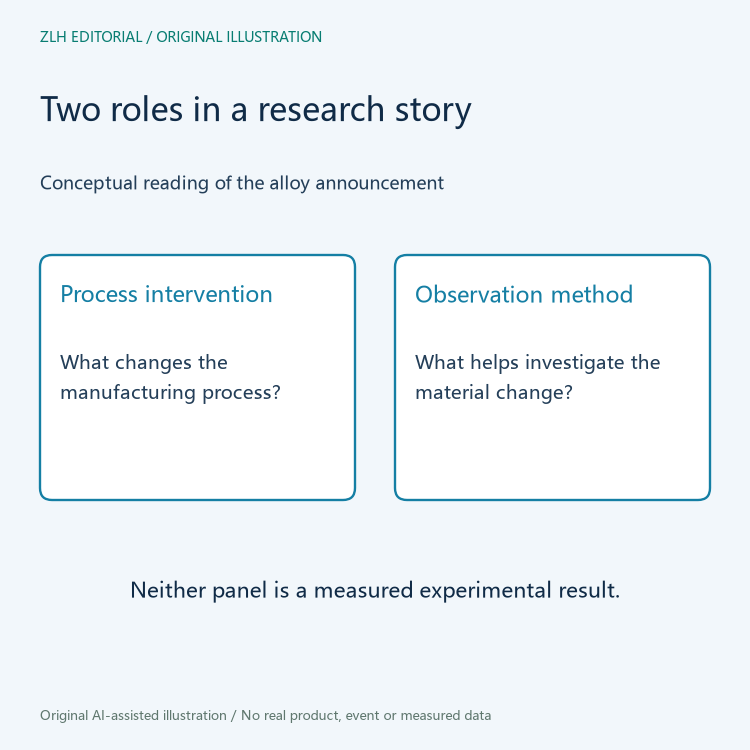
The same care applies to a before-and-after picture. A conceptual diagram can distinguish the stages being discussed, but it should not imitate photographs of experimental samples. Readers should be able to tell whether they are looking at an explanation of an idea or evidence produced by a real study. The visual form should make that difference obvious.
Monitoring belongs to the question being investigated
NIST’s Advanced Machines, Monitoring, and Control for Additive Manufacturing project discusses research into monitoring and control methods. The project page provides broader context for the importance of observing manufacturing processes. It does not mean that every available sensor can establish every property of a printed part.
For the hypothetical slide, ask what an observation is intended to explain. Is the reader being shown a process event, an interpretation of material behavior, or a separate claim about a finished object? Those are editorial questions for organizing the explanation. They should not be presented as additional findings attributed to NIST.
An observation can be relevant without answering the entire manufacturing question. A report might illuminate one relationship while leaving other properties outside its scope. A careful summary names that boundary rather than using a broad phrase such as “complete verification.” This preserves the usefulness of the reported evidence instead of asking it to support unrelated conclusions.
Do not turn research potential into a production promise
A reader interested in applying research will naturally ask about equipment, material, and production conditions. An editorial article can identify those as questions for further investigation. It cannot fill the answers from the fact that a research announcement exists. Specific adoption would need its own responsible engineering assessment and evidence.
In our proposed slide review, a colleague might ask whether an existing printer can perform the method. The appropriate response is to return to the actual research and the relevant equipment context. The slide itself cannot supply compatibility. Nothing in this article authorizes changing a machine, adjusting a laser, or using an unfamiliar material.
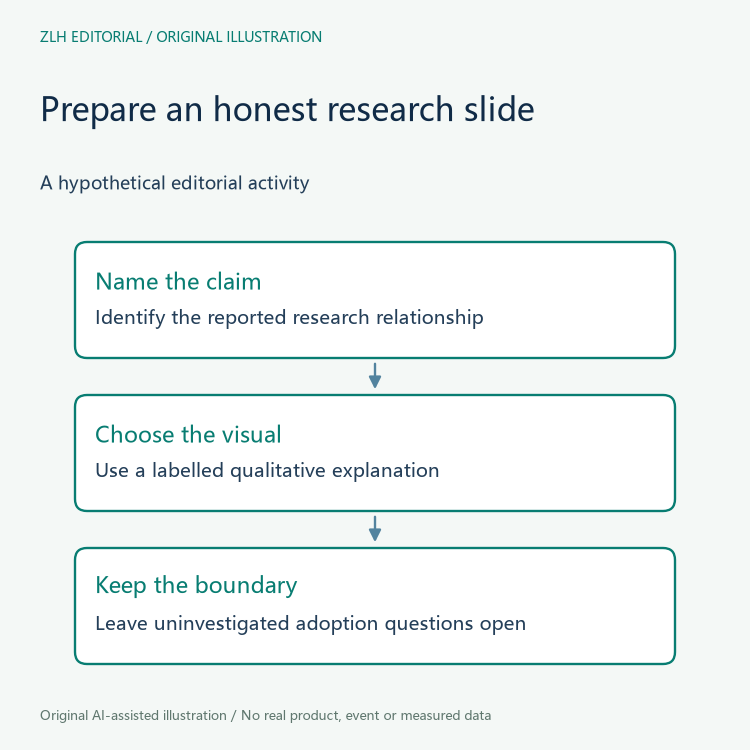
It is equally unhelpful to dismiss the news because it is not an immediate purchase specification. Research can improve the questions a manufacturing team asks before a project begins. Understanding which observation supports which claim is a useful step even when no deployment decision follows. The distinction keeps learning and implementation in their appropriate places.
Keep the explanation open to a more detailed reading
A concise research note can name the announcement date, the reported intervention, the observation role, and the questions the editor has not investigated. It can then direct readers back to the primary material. That makes a summary a route into the research rather than a substitute for the experiment.
Our additive manufacturing articles offer related reading, and the topic directory collects other manufacturing discussions. Both illustrations here are original explanatory aids. They contain no measured traces, sample photographs, material recipes, or locally obtained results. The news is most informative when its process contribution and its evidence remain distinguishable.


