

Additive Data Practice: Separate JSON Texts Before Parsing
2026-11-02
Additive Data Practice: Separate JSON Texts Before Parsing
JSON texts need an understood boundary before an additive-manufacturing data reader can interpret them reliably. A file may be intended as one document, or a producer and reader may have agreed on a sequence arrangement. This practical article proposes an offline exercise about that distinction. It contains no build data, sensor measurements, machine output, or executed parser result. The reader first decides what input unit the task actually supplies.
Name the input unit before opening a parser
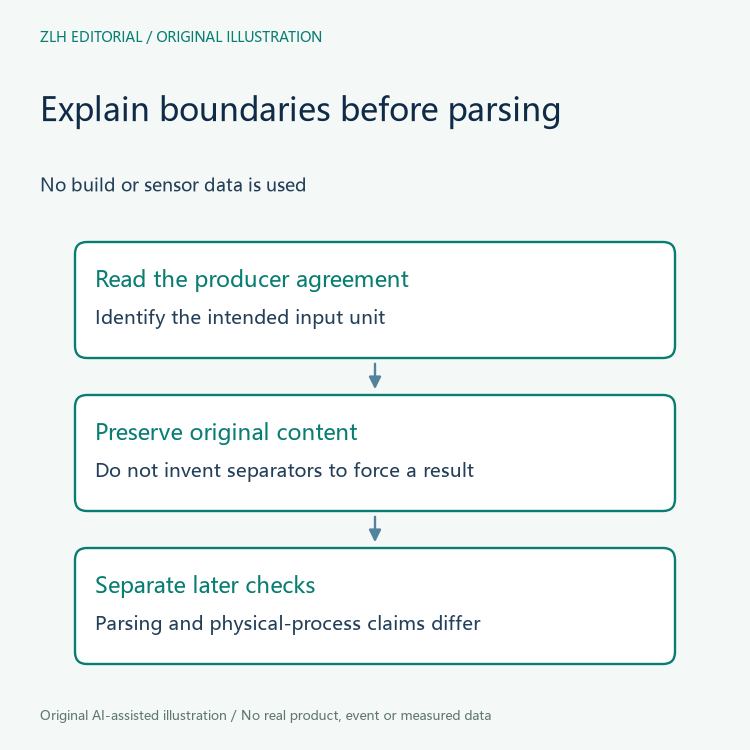
Imagine a teaching package described as a collection of additive-process notes. The description alone does not say whether the package contains one JSON document or separately framed texts. A learner should ask how the producer expects a reader to identify the beginning and end of each intended unit.
The JSON specification describes a JSON text as a serialized value. That fact helps frame the question, but it does not supply an unstated agreement for an arbitrary sequence file. The exercise should obtain that agreement from the prepared material.
Keep the original authorized input unchanged while discussing the question. The learner should not insert separators, remove line breaks, or wrap everything in a new structure merely to get a convenient result. Such edits would create a different representation before the original intent was understood.

Do not confuse a visual line with an agreed boundary
A text editor can display content across several lines for readability. A proposed sequence arrangement might also use a line convention, but that convention needs to be specified. The visible shape of the file is not enough to decide how a reader should split it.
For the fictional lesson, ask learners to explain whether line breaks belong to presentation or to the agreed framing rule. If they cannot answer, retain the question rather than treating every displayed line as a complete process note. The article supplies no sample trace that could be mistaken for actual machine data.
The same principle applies when a file extension suggests a familiar convention. The name can guide an inquiry, but the intended reader arrangement should still be explained. An editor should not silently convert a naming hint into a documented property of the contents.
Keep serialization separate from sequence design
The Python json documentation notes that JSON is not a framed protocol. A writer repeatedly serializing objects to one stream therefore does not automatically define a valid single-document arrangement. The producer and reader need a clear input design.
This exercise does not choose a universal design for every additive system. It asks the learner to identify the one the training material claims to use. One document and an explicitly framed sequence may serve different needs; their suitability depends on the actual task and environment.
No new file is generated here. If an instructor later demonstrates a writer, the observation should identify what was produced and how a reader is expected to consume it. The learner should not call the output a verified sequence simply because serialization returned without an obvious error.
Separate boundary problems from content questions
Once the intended unit is established, a later check can ask whether a selected unit can be parsed. That is still different from determining whether its contents describe a real build correctly. A technical reader cannot establish the physical process merely by recognizing a data structure.
For the fictional package, keep these questions in separate parts of the lesson. A parsing difficulty should not immediately be attributed to a sensor or machine. The input arrangement, selected unit, and tool context may need explanation before any cause is proposed.
If the instructor has supplied only a reading plan, no result should be invented. Learners can explain what they would examine next and why. They should not copy a documentation example and relabel it as output from an additive manufacturing cell.
Review whether another reader can follow the agreement
At the end, ask a colleague to describe the input unit without seeing the first learner’s parser choice. They should be able to identify the stated boundary rule and the questions it leaves open. If their interpretation differs, clarify the agreement before further processing.
A useful note can say whether it concerns one document or a framed sequence, what establishes the selected boundary, and which observations have actually been made. It need not contain a complete transformation pipeline. The immediate goal is a clear, bounded reading task.
Further methods appear in our additive automation data section and the article directory. Both original illustrations are qualitative. They contain no build record, sensor values, production claims, or software execution result.


