

Additive Schema Acceptance: Resolve the Reference Context
2026-11-02
Additive Schema Acceptance: Resolve the Reference Context
A schema reference in an additive-manufacturing data package can point beyond the document the buyer first opens. A supplier may deliver an apparently complete schema while leaving the receiver uncertain about the rules reached through its references. This article develops a proposed acceptance conversation about that dependency context. It validates no manufacturing record and describes no actual supplier package. The aim is to make the intended interpretation reproducible before an acceptance decision is requested.
Begin with the delivered schema rather than its filename
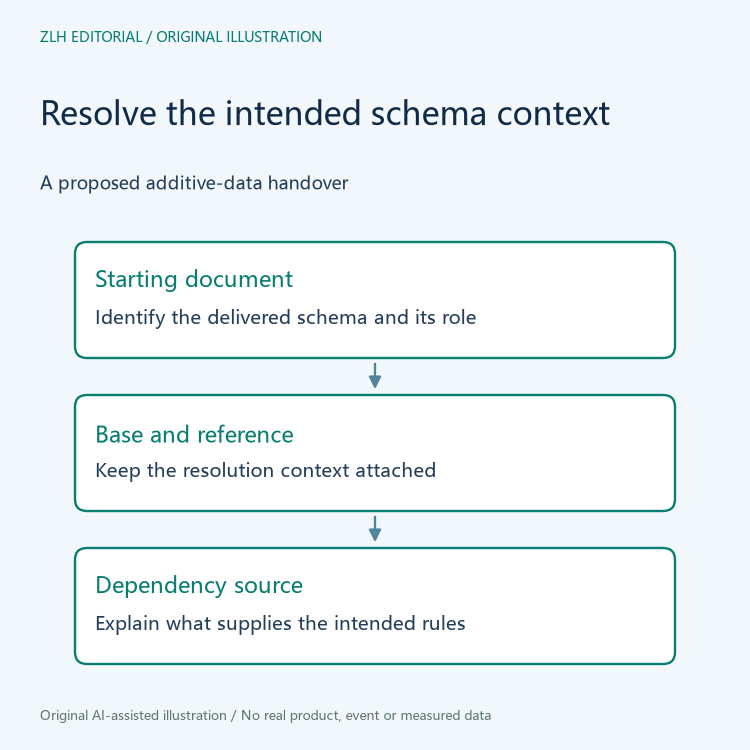
Ask the supplier which schema document is the starting point for the agreed data review. Record the document identity, its declared dialect where applicable, and the copy included in the handover. A familiar filename should not substitute for those details. Different folders can contain documents with the same displayed name.
The buyer should also ask what the schema is expected to describe. A geometry-related metadata record and a production-history record can have different rules even when both belong to an additive cell. The proposed review should identify the particular receiving task rather than describe the entire workcell as schema compliant.
Make the dependency question explicit in the acceptance checklist: can another authorized receiver identify the same intended rules using the supplied material and instructions? This is narrower than asking whether the package looks organized. It gives the supplier a specific explanation to provide without inventing a validation result.
Ask how the base URI is established
The official JSON Schema structuring guide explains base URIs, retrieval URIs, and the role of identifiers in schema documents. Relative references are interpreted against the applicable base. The receiving team therefore needs more than the relative string copied into an email.
Request an account of the actual base context used for the delivered schema. Do not assume that a desktop folder location is necessarily the base intended by the schema author. Likewise, a web-looking identifier should not automatically be described as a URL that the receiving implementation must download.
The guide distinguishes schema identifiers from network-addressable resources and describes implementations that load schemas into an internal database. The acceptance discussion should establish how the actual receiving implementation obtains dependencies. Documentation of a possible mechanism is not evidence that the current receiver uses it.
Preserve relative references with their resolution context
RFC 3986 defines generic URI reference resolution. Its value here is the distinction between a reference and the base needed to interpret it. A relative reference should not be treated as a self-contained identity when the relevant context is missing.
Ask the supplier to retain the original reference representation and explain the intended target. Rewriting a reference to match a convenient local folder can change the handover being reviewed. If a correction is necessary, keep the original and identify the revised material rather than silently replacing it.
For a proposed dependency inventory, record which supplied document or authorized resolution mechanism is expected to satisfy each reference. Unresolved dependencies should remain visible. Do not invent a plausible remote target, fetch unrelated resources, or report that a validator followed references when no validation took place.
Separate dependency availability from rule applicability
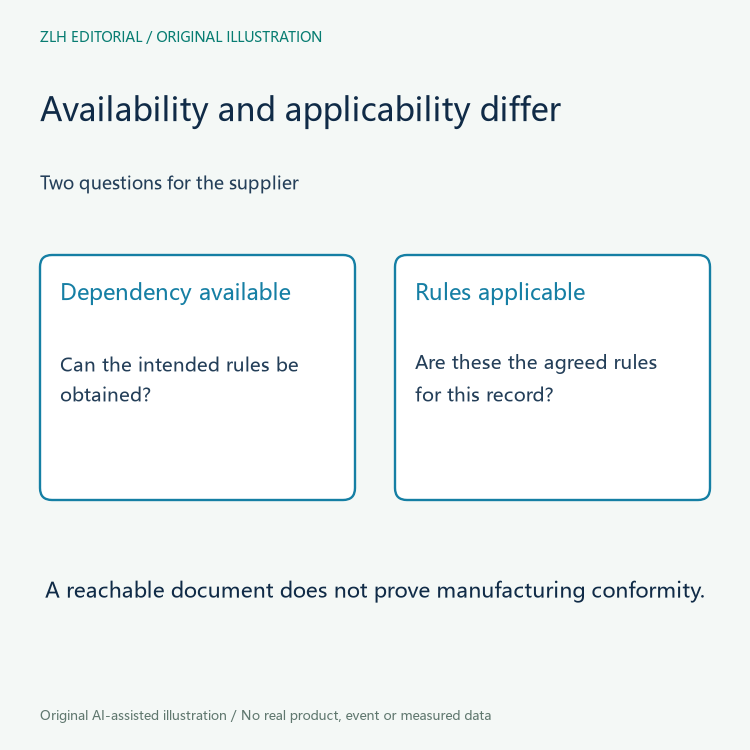
Even if all intended schema documents are available, the buyer still needs to know whether they are the rules agreed for the delivered record type. Availability answers a retrieval question. Applicability concerns the relationship between those rules, the data object, and the acceptance purpose.
A supplier might later provide an actual validator record. It should identify the input document, implementation context, and dependencies used. A success label without that information leaves the receiver unable to tell which rules were applied. The present article offers no such record and makes no claim about a real dataset.
Changes also deserve separate treatment. Replacing a dependency while retaining the same starting filename can alter the effective review. Ask the supplier to explain the dependency change and which earlier conclusions need renewed examination. Preserve the earlier package with its actual scope.
Finish with a handover another reviewer can follow
The proposed acceptance note should connect the starting schema, its base context, the reference representations, and the intended dependency source. It should distinguish supplied evidence from unresolved questions. This provides a clear route for the supplier to address missing information.
It does not establish that a printed part meets a drawing, that a cell is capable, or that production records are true. Those are different claims requiring appropriate evidence. Schema interpretation remains a bounded document task within a broader manufacturing handover.
Further editorial material appears in our additive integration section and the article directory. Both original diagrams show proposed review relationships, without real schema identifiers, manufacturing values, network retrievals, or completed acceptance results.


